Maximize ROI with Xcel Energy’s Commercial Solar*Rewards® in Boulder
Xcel commercial solar rewards in Boulder can add real value to a properly designed system. But the incentives don’t pay out automatically. Xcel Energy’s Solar*Rewards program pays eligible commercial owners for every kilowatt-hour their system produces. These payments can add to the savings and incentives available through a solar project.
For a Boulder property, the real ROI question isn’t whether the incentives exist. It’s whether your roof, your load, and your paperwork are built to capture every dollar of them.
Boulder sits inside Xcel Energy’s Colorado electric territory. So does Denver and the rest of the Front Range. Boulder businesses on an Xcel commercial demand rate qualify for the same Solar*Rewards structure Xcel offers anywhere else in that territory.
But qualifying and collecting are two different things. A system sized wrong, or permitted late, can leave incentive money on the table. That’s where the build matters most.
Understanding Xcel Commercial Solar Rewards in Colorado
Xcel’s Commercial and Industrial Solar*Rewards tier doesn’t hand you a check at signing. Eligible systems receive a payment based on solar production over the applicable contract term. The associated renewable energy credits are transferred under the program. It pays a set rate per kilowatt-hour, over a 20-year contracted term.
Xcel’s published program materials list the following Solar*Rewards C&I incentive tiers. Systems from 8 to 250 kW earn $0.04 per kWh. Systems from 250.1 to 500 kW earn $0.0475. Systems from 500.1 kW to 1 MW earn $0.045. System size is measured in AC, from 8 kW to 1 MW. There is no upfront incentive. A $50 per kW AC deposit goes in with the application. From the date that deposit is received, you have 18 months to finish. One six-month extension is available, and it forfeits the deposit. Confirm current numbers on Xcel’s Solar*Rewards page before you apply.
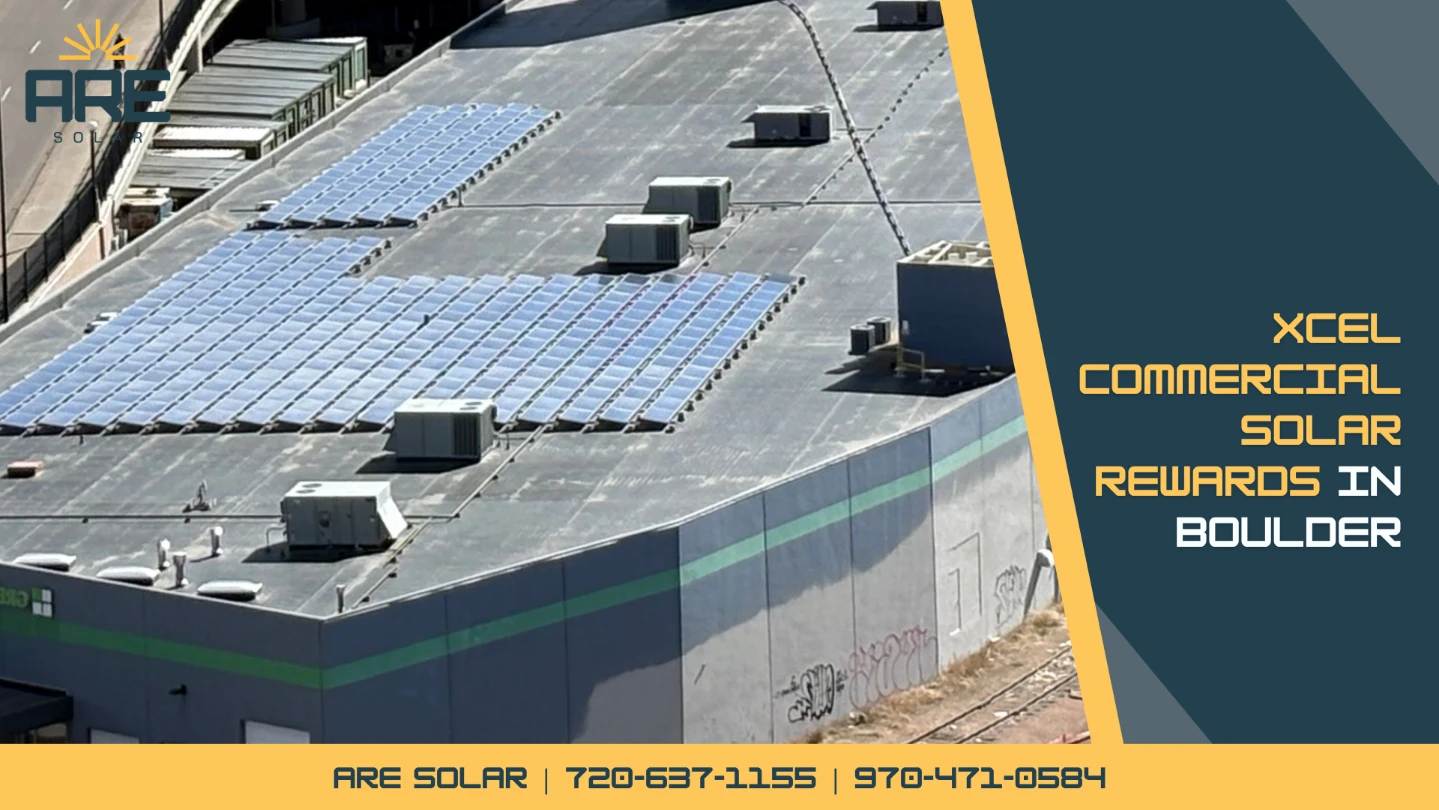
Picture a 20,000-square-foot warehouse roof in Gunbarrel. Its usable roof area might support a system large enough to shift Solar*Rewards tiers. The actual tier depends on the system’s qualifying capacity, not the roof’s total square footage.
Xcel’s Income Qualified and Disproportionately Impacted Community adder can provide additional upfront incentives for eligible solar projects. Eligibility there is narrower than most businesses expect.
Eligibility depends on location and who it serves. Because program requirements and funding can change, businesses should confirm their eligibility before applying. Guessing at eligibility wastes your application time.
The Federal Window Is Real, and It’s Tighter Than It Was
The federal Investment Tax Credit still applies to many commercial solar projects. It falls under Section 48E. It provides a 6% base credit for qualifying commercial solar projects. It can increase to 30% when applicable prevailing wage and registered apprenticeship requirements are met.
Projects that began construction by July 4, 2026 may remain outside the accelerated termination rules, subject to applicable IRS requirements. Those projects generally have until the end of the fourth calendar year after construction starts.
Projects beginning construction after that date face the December 31, 2027 placed-in-service deadline.
That tighter window doesn’t mean a business should rush a poor design. It means commercial solar planning has to start earlier. Engineering, permitting, utility coordination, and scheduling all affect the timeline.
A Boulder biotech campus with capital ready may have more flexibility. A Pearl Street retailer still lining up financing may need a more deliberate plan. Both projects need the same foundation: accurate design, proper permitting, and a realistic schedule.
Boulder Conditions Change the Engineering, Not the Sales Pitch
Boulder’s snow loads and wind exposure aren’t decorative details on a permit application. They’re structural math. Older commercial roofs may not carry the dead, live, snow, and wind loads of a modern array. Our structural engineers run that math first.
Boulder also regulates something most Colorado cities don’t: shadows. New buildings and additions in certain zones must submit a solar access analysis. That’s required under the city’s Solar Access Guide. That rule protects neighboring properties from being shaded out by new development. It constrains building height and massing, not where your panels go.
City of Boulder commercial permits run through Planning and Development Services. Properties in unincorporated Boulder County fall under a different department entirely: County Community Planning and Permitting. Interconnection runs through Xcel, separately from either building permit.
Ask These Questions Before You Sign Anything
A lower bid often means a different scope, not a better deal. Before hiring anyone for a Boulder commercial system, ask a few direct questions.
- Is your contractor properly licensed and authorized for the work required by the project and its jurisdiction?
- Do they design racking and structural attachments for Boulder’s snow and wind load code, or use a generic spec?
- Do they carry the project through permitting, inspection, and Permission to Operate, or hand it off partway?
- Have they named the exact REC rate and IQ/DIC eligibility for your system size, in writing?
If an answer is vague, that’s the answer.
FAQ: Xcel Commercial Solar*Rewards in Boulder
Who is eligible for Xcel Solar*Rewards C&I in Colorado? Xcel Solar*Rewards C&I is available for qualifying commercial customers in Colorado. Eligible applicants may include businesses, nonprofits, and other organizations served by Xcel Energy. Projects must meet Xcel’s program requirements for system size, equipment, and interconnection.
Does my business qualify for the Income Qualified or DIC adder? Not automatically. Outside a Disproportionately Impacted Community, a commercial applicant generally has to be a nonprofit, a government entity, or a multifamily affordable housing provider. Inside a DIC, the list is broader. It includes schools, places of worship, community centers, and locally owned businesses. Franchises are excluded. Confirm your address and your entity type with Xcel before you count on the adder.
Can a Boulder business still qualify for the Section 48E solar tax credit in 2026? Projects that began construction by July 4, 2026 may fall under different transition rules. Projects beginning construction after that date generally face the December 31, 2027 placed-in-service deadline. Check the details with a tax advisor. The Colorado Energy Office can also help confirm your timeline.
How long does Boulder commercial solar permitting take? It depends on your building’s jurisdiction and structural review needs. Some Boulder properties fall under city permitting; others fall under the county. Your exact timeline should be scoped during the site assessment.
Does the Boulder solar access ordinance affect my project? It depends on your zoning. Solar Access Areas I and II carry a solar fence. A new building or addition there needs a shadow analysis with the permit application. Area I covers RR-1, RR-2, RE, RL-1, and MH. Area II covers RL-2, RM, RMX, RH-1 through RH-5, MU-1, MU-3, and I. Everything else is Area III, with no solar fence and no analysis requirement. Many of the commercial and downtown zones sit in Area III.
What happens if my current installer stalls before Permission to Operate? We inspect the existing work and document what remains. We then explain the steps needed to complete the project properly.
Why does Xcel Energy’s Commercial Solar*Rewards program matter specifically for a Boulder building? Because Boulder’s roofs and system sizes vary block by block. A Pearl Street retail roof and a Gunbarrel warehouse roof sit in different REC rate tiers. Getting those details right is what turns the incentive into real revenue.
Does Solar*Rewards® Apply to Every Commercial Property? No. Program availability and requirements depend on the project details, utility rules, and current program structure. Property owners should verify eligibility directly with Xcel Energy before making financial decisions.
ARE Solar reviews the full project before recommending a path forward. The building, electrical system, and energy goals all matter.
Let’s Look at Your Roof
If you’re evaluating Xcel’s Commercial Solar*Rewards, start with the building itself. Every Boulder commercial roof carries its own load calculations and its own incentive math. ARE Solar reviews your roof, electrical infrastructure, energy usage, and timing, before you commit to anything. We’d rather walk your roof than guess. Call ARE Solar, and find out exactly what your building qualifies for. The next incentive deadline won’t wait.