Commercial solar battery storage in Boulder County can do more than provide another place to put excess solar production. For the right commercial property, storage can reduce peak grid demand. It may also lower demand charges.
That starts with understanding when the building’s peaks actually occur. Solar alone cannot reduce an after-sunset demand peak at the time it happens. A properly designed battery may be able to discharge during that window.
Location matters too. The City of Boulder is served by Xcel Energy. Longmont operates its own municipal utility, Longmont Power & Communications (LPC). Their commercial rates and distributed-energy requirements are different. In 2026, the City of Boulder also expanded an existing tax rebate to qualifying battery energy storage systems.
Battery planning should start with the building, utility, and actual load profile. Avoid choosing a generic battery size.
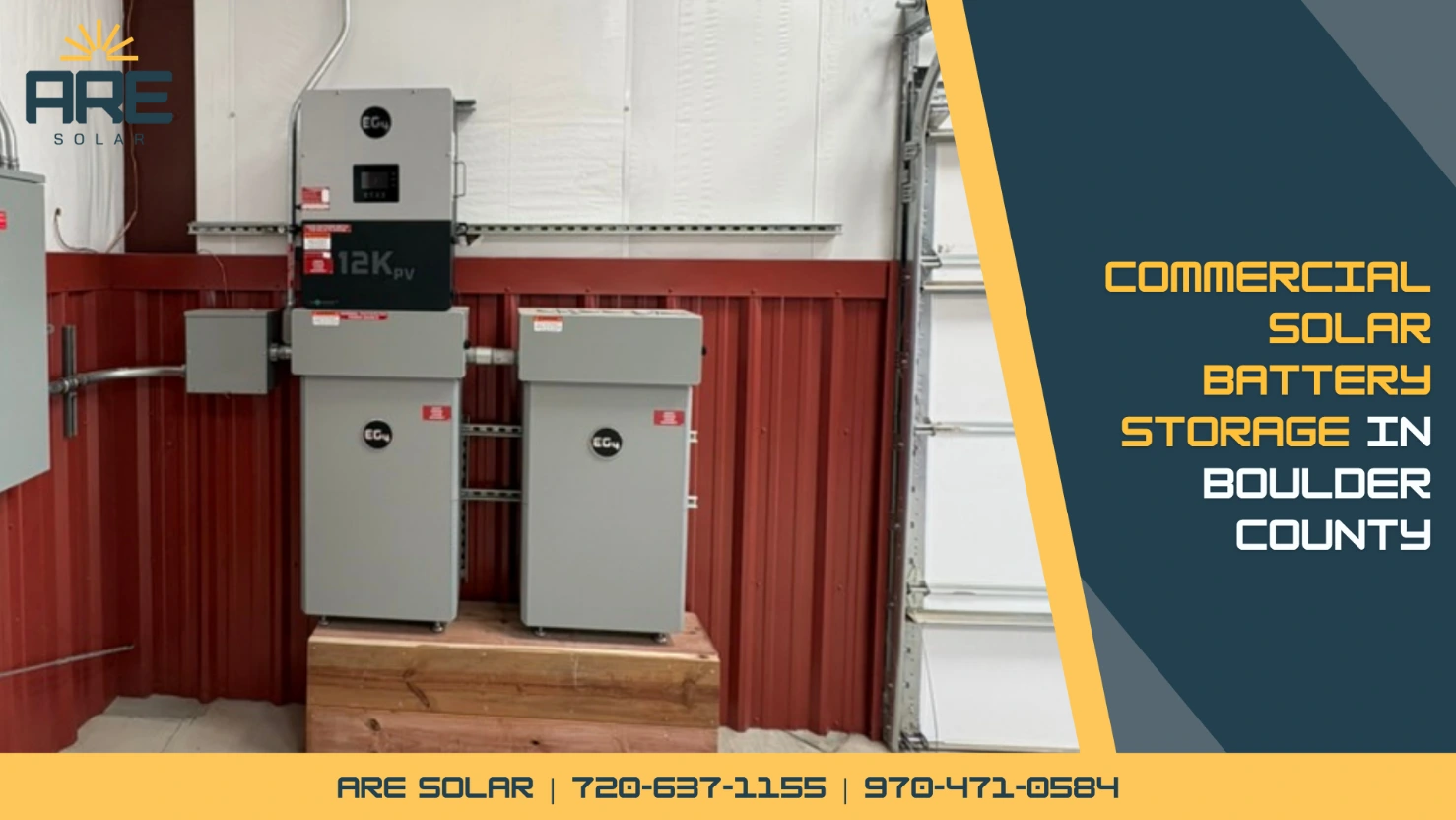
Commercial Solar Battery Storage in Boulder County: What’s New in 2026
In April 2026, the City of Boulder expanded its solar tax rebate to include qualifying permanent battery storage systems.
The distinction between Boulder and Boulder County matters. This is a City of Boulder program. A property does not automatically qualify simply because it is located somewhere in Boulder County.
Eligible installations may receive a rebate of approximately 15%. The rebate applies to City sales and use taxes paid on materials and permits for the solar installation. Eligible battery systems must meet the City’s program requirements. This includes requirements related to permanent installation and operation in parallel with the electric utility grid.
Applications must be submitted within 12 months of the City’s final inspection, and rebates are subject to funding availability.
For a commercial property considering storage, the rebate can improve project economics. However, it should be treated as one part of the financial analysis rather than the reason to install a battery.
Why Does Boulder County Have Two Different Utility Rulebooks?
Commercial properties in the area do not all operate under the same electric utility.
Xcel Energy serves most of Boulder County, including the city of Boulder. The City of Longmont runs its own municipal utility, Longmont Power and Communications. United Power, and Poudre Valley REA also serve parts of the area. Checking the property’s utility provider should be an early step when evaluating solar.
LPC maintains its own commercial electric rates, self-generation credits, and interconnection requirements. System size follows the city’s interconnection standards rather than the rate schedule, and larger projects receive case-by-case review.
That difference matters when evaluating battery storage. A battery that makes financial sense under one utility tariff may perform differently financially under another.
How Does a Battery Actually Cut a Demand Charge?
Commercial electric bills may include demand charges based on a property’s highest measured demand. The measurement interval and billing rules depend on the tariff.
Imagine a commercial building that normally operates around 80 kW. Several large loads can briefly push demand to 120 kW. If the rate bills demand based on peak usage, that brief increase can raise demand charges.
A battery can be controlled to discharge when building demand approaches a predetermined threshold. Instead of drawing the entire spike from the grid, part of the load can temporarily be supplied by stored energy.
That strategy is commonly called peak shaving.
The battery needs enough power to reduce the peak and enough energy to sustain that reduction. Its controls must respond to building demand without depleting the battery before the key peak occurs.
Longmont’s Municipal Utility Plays by Different Rules
Under LPC’s current Commercial Demand rate, billed demand is based on the highest 15-minute average during the billing period.
The currently published demand charge is $21.00 per kW during the summer period. It is $19.10 per kW during the non-summer period.
Longmont also changed how newer self-generation systems are credited. Systems that qualified under the older legacy structure can receive different treatment from systems under the newer self-generation rates.
LPC’s currently published generation credits for the newer commercial self-generation rate classes are 9.62 cents per kWh for CEGE and 5.60 cents per kWh for CDGE and CCGE. Utility rates can change, so project modeling should use the rate in effect when the analysis is performed.
Battery efficiency, capacity, degradation, cost, controls, demand charges, export compensation, financing, and load profile all affect the result. Reducing monthly peaks can lower demand charges. The value depends on consistent peak reduction versus storage costs.
Is Battery Storage Just About Saving Money?
No. Commercial batteries can also support resilience when they are specifically designed for backup operation.
A battery sitting on a commercial property does not automatically mean the building will have power during an outage.
Backup operation requires an appropriate system design. Electrical configuration, controls, battery capacity, state of charge, and selected backup loads determine what stays powered and for how long.
Where Does Boulder’s Building Performance Ordinance Fit In?
The City of Boulder is also changing how it approaches energy performance in larger buildings.
The City’s Healthy Buildings, Stronger Community roadmap includes work in 2026. This replaces the Building Performance Ordinance’s audit, lighting, and retro-commissioning mandates. It aims to align requirements for commercial and multifamily buildings over 50,000 square feet with Colorado’s building-performance standards.
That does not mean affected buildings are required to install batteries.
It increases the importance of understanding how a building actually uses energy and which improvements make sense for that property. Efficiency upgrades, electrification, solar, controls, operational changes, and battery storage can support a broader energy strategy.
Storage’s role in compliance depends on the building and how applicable performance requirements treat its energy use.
Permitting a Battery in Boulder County
Permitting authority depends on the property’s location.
A project within the City of Boulder goes through the City’s permitting process. Longmont handles projects within its jurisdiction separately, while Boulder County oversees applicable projects in unincorporated areas.
Commercial battery permitting can involve electrical plans, equipment specifications, disconnects, labeling, equipment locations, and fire-safety requirements. The exact requirements depend on the system design and the codes adopted by the authority having jurisdiction.
Battery storage also introduces considerations that are different from installing solar panels alone. Equipment location, clearances, electrical configuration, emergency access, and utility connections can all affect battery design.
FAQ: Commercial Solar Battery Storage in Boulder County
Does Boulder’s new rebate cover commercial battery systems?
Qualifying commercial properties within the City of Boulder may be eligible. The City’s 2026 update expanded its solar tax rebate to qualifying permanent battery storage systems. It is not a blanket Boulder County rebate, and technical requirements, application rules, and available program funding apply.
Does Longmont offer the same incentives as Xcel-served areas?
No. Longmont Power & Communications operates its own municipal electric utility. It maintains its own commercial rates, self-generation credits, and interconnection requirements. That’s why the utility and applicable rate should be identified before modeling solar or battery storage value.
Can a battery help during a utility power safety event?
Yes, if the system is specifically designed for backup operation. Battery capacity alone does not guarantee backup power. The battery’s power rating, state of charge, controls, electrical design, and critical loads determine what stays powered and how long.
How is battery sizing different from solar sizing?
Solar sizing considers energy use, array space, production potential, utility requirements, and project goals. Battery sizing considers demand data, peak magnitude and duration, capacity, utility rates, backup needs, solar production, and operating strategy. A building’s annual kWh total alone is not enough to size either system properly.
Do I need a permit for a battery in Boulder County?
Commercial battery installations generally require permitting, but the responsible authority depends on the property’s location. Projects may fall under the City of Boulder, City of Longmont, or Boulder County for applicable unincorporated properties. The required plans and safety provisions depend on the jurisdiction, equipment, and system design.
Ready to Size Your Battery
A commercial battery should start with the building’s load data, utility rate, operating schedule, and resilience goals, not a one-size-fits-all capacity recommendation.
ARE Solar evaluates interval demand, solar production where applicable, utility requirements, and available incentives before recommending a storage strategy. That analysis can show whether the opportunity is reducing peak demand, increasing onsite use of solar energy, providing backup for critical loads, or combining several objectives in one system.
Contact ARE Solar to find out where your building’s peaks occur, what they are costing you, and whether commercial battery storage can reduce them.