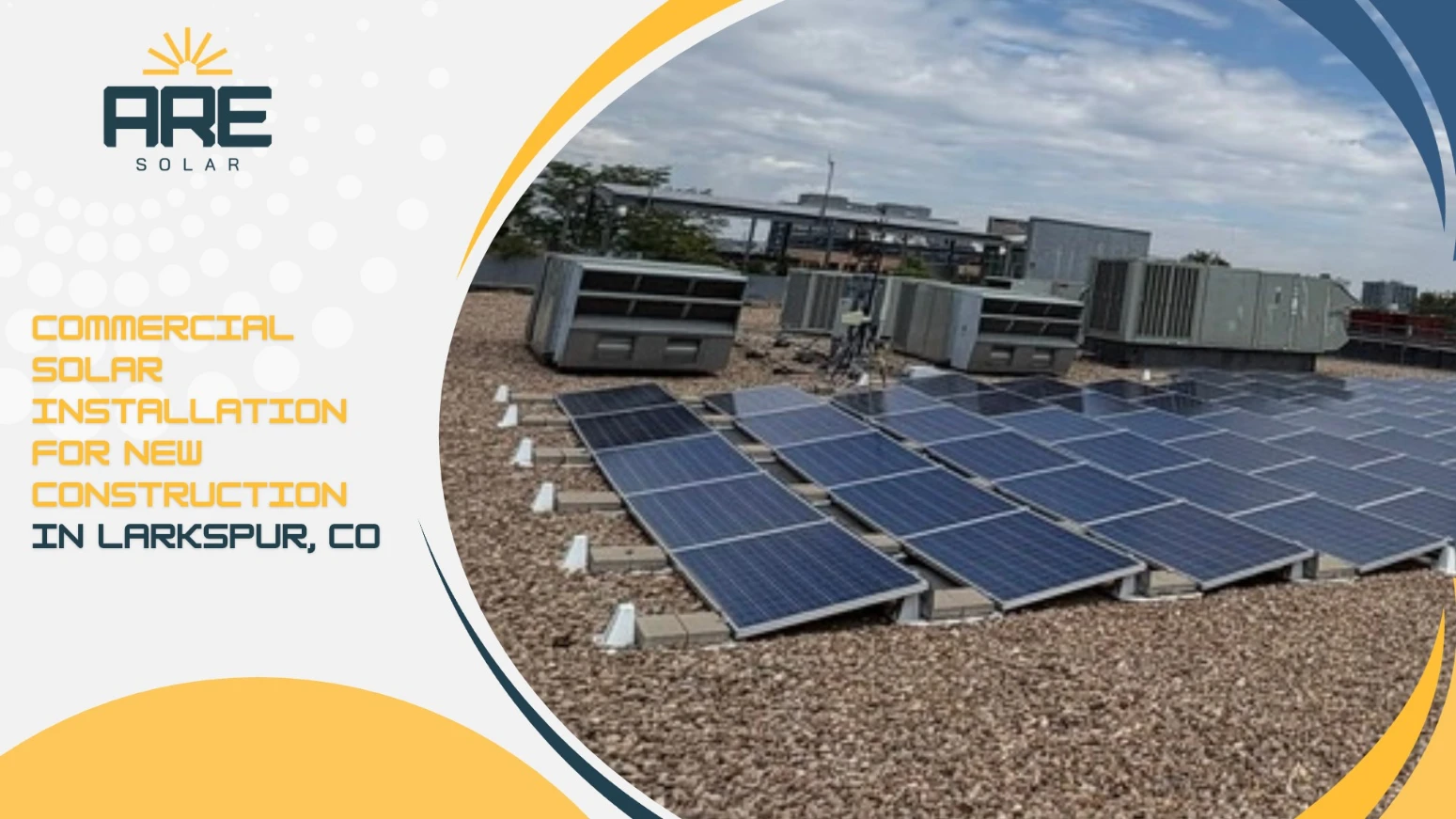
Commercial solar installation for new construction in Larkspur, CO comes down to four early decisions. Confirm which office reviews your site. Confirm your utility and how it pays for exported power. Give your structural engineer the array’s weight and the local snow load. Then build a schedule around the federal tax credit deadline.
Get those right, and the array goes in as part of the building. Miss them, and someone redesigns a roof that’s already framed.
Our guide to new construction commercial solar in Arvada covers loads, switchgear, and storage. This guide covers what changes on the Palmer Divide.
Which Office Reviews Commercial Solar Installation for New Construction in Larkspur, CO?
Start with the address. Inside town limits, the Town of Larkspur Building Department handles land use applications and building permits. SAFEbuilt provides its plan review and inspections.
The Town adds a step many builders miss. Its site plan rules apply in the zone districts they cover. No permit issues for a new building, parking area, or loading area without an approved site plan. The process opens with a pre-application conference. A sketch plan is due at least five days before it.
Our advice is to put the array on that sketch plan. The Town doesn’t require it, but it saves rework. Show the panels, the meter, and the equipment pad from day one.
Outside town limits, Douglas County reviews the project. The County adopted 2024 building codes on July 1, 2026. Douglas County’s adoption of the 2026 National Electrical Code takes effect January 1, 2027. Two sites a few miles apart can face different code editions.
State law also shapes solar-ready commercial buildings. Local governments updating any building code after July 1, 2026 must adopt the Model Low Energy and Carbon Code. A stricter or equivalent code also qualifies. Some offices still enforce the earlier solar-ready code. Ask your reviewing office which energy code governs your permit.
Design Around How CORE Pays for Solar
Many Larkspur-area sites are served by CORE Electric Cooperative. Mountain View Electric Association also serves parts of Douglas County. Confirm the utility by address before anyone sizes an array.
On CORE, the size of the array changes how it gets paid. Under Colorado’s co-op rules, qualifying commercial systems up to 25 kW can be net metered. Interconnection requirements still apply. Larger systems generally go through CORE’s qualifying facility process. Exports from those systems are paid at CORE’s applicable avoided cost. That rate is far below the retail price of power.
That gap shapes commercial solar installation for new construction in Larkspur, CO. Power the building uses itself is worth far more than power it exports. To be real, an oversized array on a co-op meter sells its best hours cheaply. Size it to daytime load. The roof’s full area is not the target.
Demand charges add a new-building wrinkle. CORE bills most non-residential members on their highest 15-minute demand each month. Startup and commissioning can create a building’s biggest early spike. Stagger the rooftop units and test loads that week. Plan it with CORE before the meter is set.
CORE’s largest accounts face one more rule. Its Coincident Peak Distribution schedule covers qualifying non-residential accounts of 2,000 kW and up. Basic billing demand there has a floor. It can’t drop below half the highest billed basic demand of the prior 12 months. One careless startup can echo for a year.
Rates are moving, too. CORE has approved new rates starting with January 2027 bills. They average a 7.75% increase across member classes. Size the system against the tariff in force when the building opens.
Metering follows CORE’s rules too. Show the meter and disconnect locations on the site plan early. File the interconnection application once the design is stable. The utility review can then run alongside the building permit.
Give the Structural Engineer the Array Before the Roof Is Framed
The cheapest structural fix is the one made on paper. Commercial solar project planning should hand the engineer three things early. Those are array weight, attachment or ballast layout, and snow behavior around the rows.
Snow load comes from elevation here. The County handout sets 40 psf for sites between 6,500 and 6,999 feet. Confirm your parcel’s elevation, since loads change by band. Ground snow load is used as roof snow load, with no reductions allowed. The same handout sets a 115 mph design wind speed for Risk Category II buildings.
Colorado conditions add drift. Snow piles behind parapets, rooftop units, and the rows themselves. Ask the engineer to check those drift zones with the array in place.
Wildfire rules can reach the roof too. Douglas County’s Wildfire Resiliency Code requires Class A roof coverings in wildland-urban interface areas. It applies outside town limits and outside fire protection districts. Sites inside town limits follow the Town’s adopted codes instead. Where it applies, confirm the roof assembly’s fire classification early. Check the mounting system’s fire-related installation requirements before design is final.
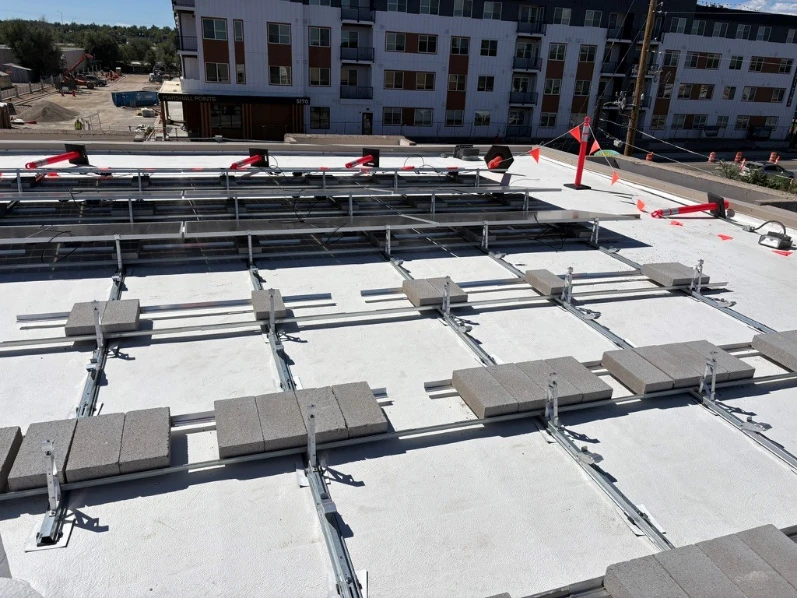
Plan the roof layout around the array as well. On new construction commercial solar, keep rooftop units, vents, and drains out of the best solar zone. Leave clear paths for fire access and service. For carports or ground mounts, the County sets a 36-inch frost depth for footings.
Does the Federal Tax Credit Still Fit a New Building Schedule?
It can, but the calendar is tight. Section 48E sets a deadline for solar projects started after July 4, 2026. They generally must be placed in service by December 31, 2027. Projects that started earlier may follow different rules. Our tax credit guide covers the basics.
A building that breaks ground next spring may not be finished by then. Placed in service is a tax test about readiness for use. It isn’t the day the panels are bolted down.
Equipment sourcing adds a second clock. Foreign-entity rules include a material-assistance cost test. It measures manufactured-product costs, not labor or design. The non-prohibited share must reach 40% for 2026 construction starts. It rises to 45% for 2027, per the Tax Law Center. The math and paperwork run deeper than those percentages. Bring your tax advisor and suppliers into commercial solar project planning before procurement.
Questions Larkspur Builders Ask About Solar
When should a solar installer join a new commercial project?
Before the site plan and roof drawings are final. Structural loads, switchgear space, and conduit paths cost little to change in design. They cost a lot to change after framing.
Are solar-ready commercial buildings ready for panels?
Not on their own. Solar-ready provisions reserve roof area and pathways. They don’t size the array, engineer the attachments, or start the utility application.
Should a new building’s array cover all of its power?
Not necessarily. On CORE, exports usually earn less than power the building avoids buying. Size around daytime demand, seasonal operations, and expected load growth. Some export is normal and isn’t a sign of oversizing. Our commercial battery guide covers storing midday power for later.
Bring Us the Roof Before the Trusses Are Ordered
Send ARE Solar your site address, schematic roof plan, and target opening date. We’ll confirm which office reviews it and which utility serves it. We’ll tell you what the roof needs to carry. Then we’ll map the solar schedule against the 2027 deadline.
Commercial solar installation for new construction in Larkspur, CO works best when it’s drawn in, not added on. Contact ARE Solar or stop by Engineers Court. The roof is still on paper. Keep it that way until the solar is in it.