Your array may be producing exactly what it did on day one. Your bill may still look different. In 2026, both utilities that serve Erie changed how they charge businesses for power.
That matters for commercial solar savings in Erie, CO. Savings are never just a production number. They come from where your array meets your rate schedule. When the rate schedule moves, the savings move with it.
Our Erie office sits at 388 Montgomery Drive. Here’s what changed this year, and how to check your own numbers.

Two Utilities, Two Different 2026 Stories
Erie sits on a utility boundary. Some businesses buy power from Xcel Energy. Others are members of United Power. We covered how to tell which one serves you in our Erie commercial maintenance guide.
This year, both utilities raised costs, in different ways. Xcel raised rates through a state rate case. United Power raised charges and changed the structure of its bills. Each one affects commercial solar energy cost savings in its own way.
What Xcel’s August Rate Change Means
In August 2026, the Colorado Public Utilities Commission approved a $157 million annual increase. Xcel had asked for $356 million. The approved amount was 56% lower. The new rates took effect August 29.
Xcel estimates the increase adds about $7.29 a month, or 4.64%, for the average small business. That figure is an average. Accounts with demand charges will see their own numbers. Your own bill shows the actual impact.
Higher rates usually help solar owners. Every kilowatt-hour your array produces now displaces a slightly more expensive one. To be real, though, the gain only shows up where solar touches the bill. Energy charges move with production. Demand and fixed charges often don’t.
United Power Moved Its Peak Window. Your Array Didn’t.
United Power’s 2026 rate change took effect for usage starting January 1. The co-op raised demand and fixed charges across rate classes. It also shortened the time-of-use peak window from 2–10 p.m. to 5–9 p.m. The new window runs Monday through Saturday, excluding holidays.
That shift is consequential for small businesses on time-of-use. Under the 2026 Small Commercial TOU schedule (CTD1), on-peak energy costs $0.2249 per kWh. Off-peak costs $0.0663.
Your array’s afternoon output between 2 and 5 p.m. used to offset peak-priced energy. Those same hours are now off-peak. The panels didn’t change. The value of their afternoon production did.
Here’s a hypothetical. Your array makes 10,000 kWh a year between 2 and 5 p.m., Monday through Saturday. At 2026 CTD1 prices, the peak and off-peak gap is about 15.9 cents. That represents a hypothetical $1,586 difference in energy value, not a confirmed loss in annual savings. Your real change depends on last year’s tariff, your usage and your solar billing.
Larger accounts face a different pressure. Large Commercial Secondary Demand Service (ISD1) bills $22.40 per kW on your highest demand at any hour. Solar trims it when production and load overlap. Evening shifts, cloudy days and big equipment starts can set a peak solar never touches.
How to Measure Commercial Solar Savings in Erie, CO
Commercial solar savings in Erie, CO show up on the bill first. Start with your bills, not your inverter app. Pull the same months from last year and this year. Then separate each bill into three lines: energy, demand and fixed charges.
Ask three questions. Did your energy charges fall the way the original proposal predicted? Did demand charges climb even while production held steady? Did fixed charges absorb part of the gain?
Comparing utility bills is a starting point, not a complete measure of solar savings. A more reliable assessment considers actual solar generation, building consumption, utility rates, and demand patterns. Interval data can help estimate what the business would have paid without solar and how much the system actually offset.
This split shows where commercial solar ROI is holding and where it slipped. It also shows which commercial solar energy cost savings were real. Steady production with falling savings points first to rates, demand or building load. Falling production needs a weather-adjusted check before anyone blames equipment.
Run a Commercial Solar System Performance Review
The production side needs its own check. A commercial solar system performance review compares actual output to a weather-adjusted model. A cloudy spring shouldn’t look like a failed string.
The Department of Energy’s federal O&M guidance tracks two numbers. Performance ratio compares actual output to modeled output. Availability measures how often the system is up. DOE cites 85% performance ratio and 95% availability as achievable targets. The right benchmark depends on your system’s design, age and weather.
If either number sags, the cause is usually findable. Our posts on monitoring alerts and Erie maintenance cover the common causes. We won’t repeat them here.
When the Building Changed, Not the System
Sometimes the array and the rates are fine. The building moved on. A new EV charger, an added production line or longer hours can all reshape your load.
New load often lands in the evening. That’s exactly when solar can’t help with demand charges. Your system was sized for the building you had. It may not match the building you run now. Our guide to demand charges and commercial solar covers that timing in depth.
What to Do If the Numbers Slipped
The fix depends on the cause.
- Rate fit: Small commercial members can compare C1 and CTD1 against their interval data. CTD1 has cheaper off-peak energy but higher demand and fixed charges. Confirm eligibility with United Power before switching.
- Evening demand: A battery sized and controlled for your peak can trim it. Weigh its cost against the demand charges it would cut. Our Boulder County storage guide walks through peak shaving.
- Underperformance: Repair what the performance review finds. Strings, inverters and connections are all testable.
- Expansion: An expansion may count as a separate investment for tax purposes. It depends on the details. Applicable solar projects beginning construction after July 4, 2026 must be placed in service by December 31, 2027. That deadline doesn’t apply to battery storage. Storage still faces federal sourcing rules. Confirm both with your tax professional. Our 2026 commercial tax credit post explains the timing.
Frequently Asked Questions
Does a utility rate increase always raise my solar savings?
Not always. Higher energy rates increase the value of each solar kWh. Higher demand or fixed charges can offset that gain.
My production is normal, but my savings dropped. Why?
Check your rate schedule first. If you’re a United Power member on time-of-use, the 2026 peak-window change can lower the value of afternoon production.
How often should a business review its solar savings?
Once a year is a good baseline. Review sooner after a rate change, a new major load or a production drop.
Can storage be added to an older system?
Often, yes. It depends on your inverter, electrical capacity and utility interconnection requirements.
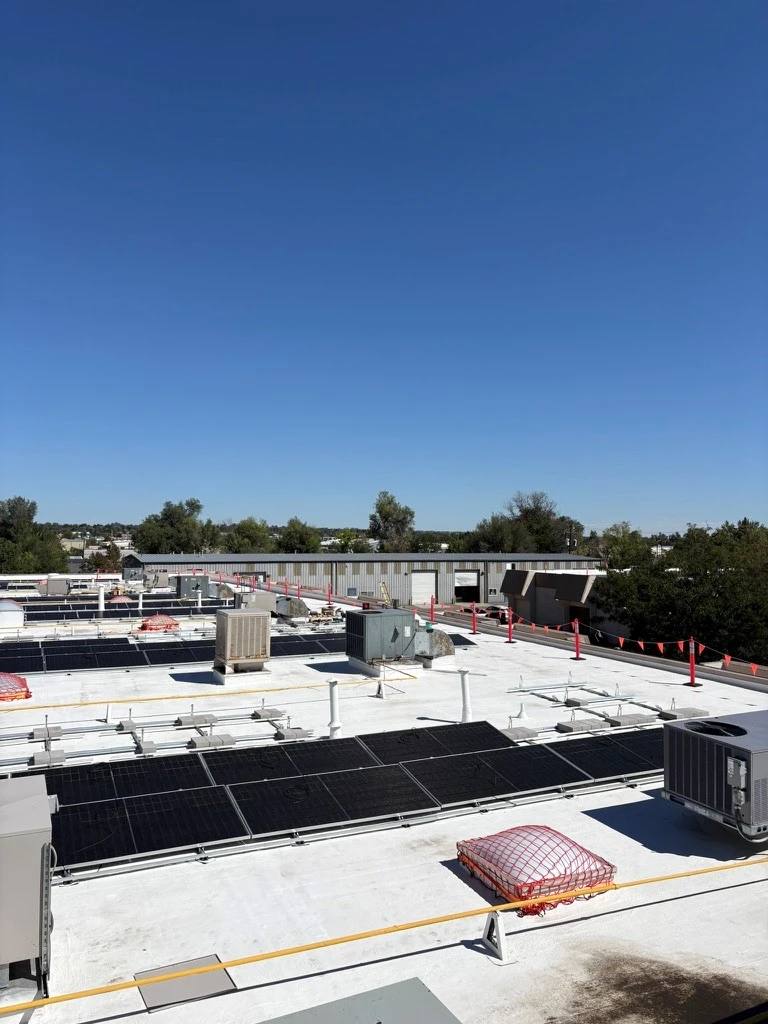
Get a Savings Check From ARE Solar’s Erie Team
We match your bills to the 2026 tariff on your meter. We pull your 15-minute interval data to find what sets your demand charge. Then we compare your array’s output to a weather-adjusted model.
You get a written answer on commercial solar savings in Erie, CO. It shows which part of your commercial solar ROI held and which slipped. If the fix is a rate switch, we’ll say so, even with nothing to install. A rate fix is still a fix.
Gather your past 12 months of utility bills, your original solar proposal, and any available production reports. Contact ARE Solar to discuss a commercial solar savings review and the next steps for evaluating your system.