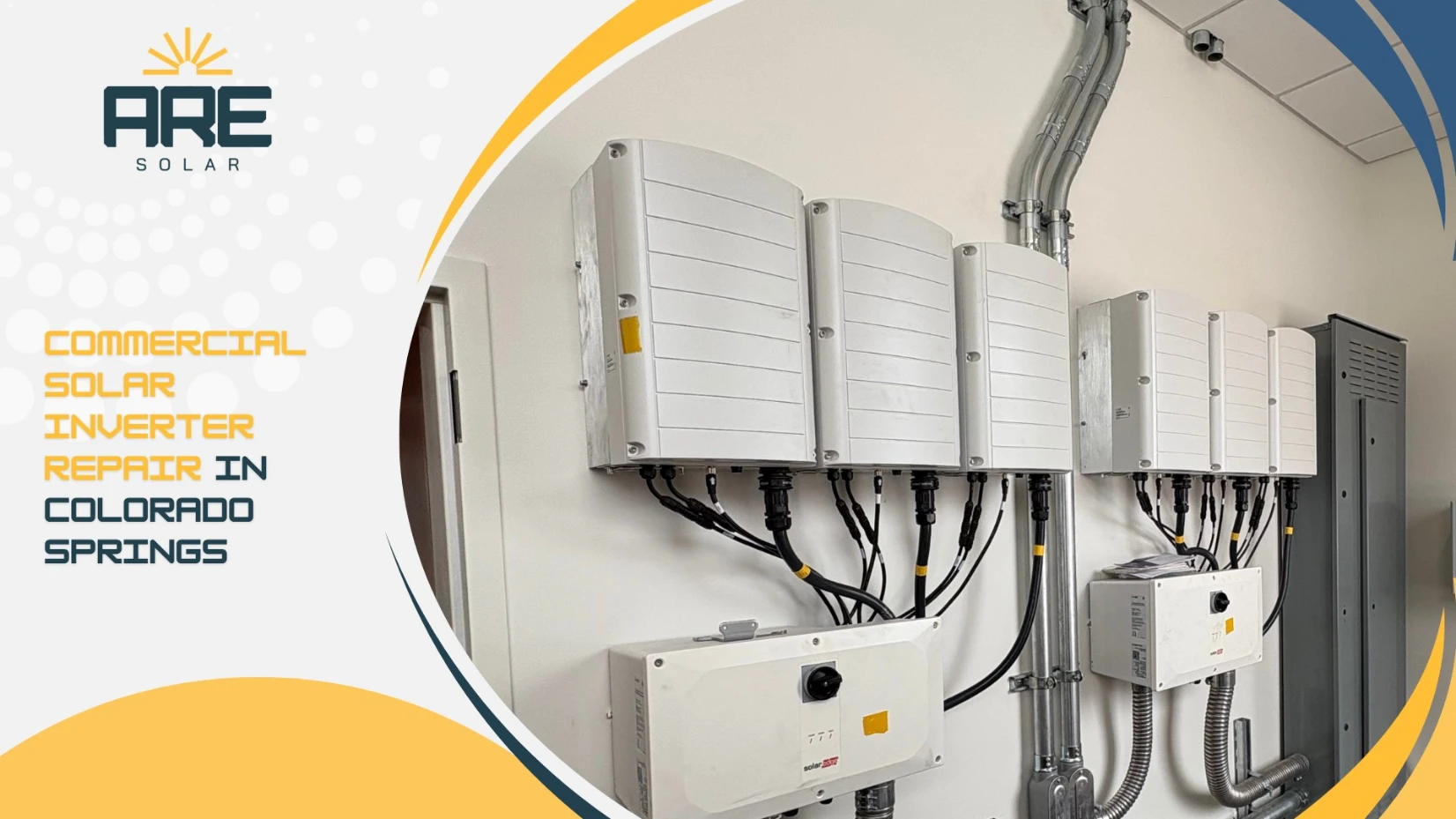
Commercial solar inverter repair in Colorado Springs starts with a question most owners never ask. Did it fail, or follow the rules?
Colorado Springs Utilities (CSU) sets those rules. Its 2026 service standards require inverter-based resources installed beginning January 1, 2023 to comply with its IEEE 1547-2018 default parameters. Any deviation requires CSU approval. Some grid conditions force a trip within 0.16 seconds. Others require the inverter to keep running.
So an offline inverter isn’t automatically a broken one. ARE Solar starts with the event record, then tests the system around the alarm. That order protects production and keeps working equipment in service.
What CSU’s 2026 Standards Require From Your Inverter
The rules live in Section 13.05 of CSU’s Electric Line Extension & Service Standards. They follow the IEEE 1547-2018 defaults, and any deviation must be approved by CSU. Voltage is shown in “per unit,” where 1.0 equals normal voltage.
The table below summarizes several key CSU thresholds rather than reproducing the full IEEE 1547 settings.
| Grid condition | What CSU requires of the inverter |
| Frequency above 62 Hz | Cease to energize and trip within 0.16 seconds |
| Frequency 61.2–61.8 Hz or 57.0–58.8 Hz | Keep operating for at least 299 seconds |
| Frequency 58.8–61.2 Hz | Operate continuously |
| Voltage above 1.2 per unit | Trip within 0.16 seconds |
| Voltage 0.88–1.10 per unit | Operate continuously |
| Voltage below 0.45 per unit | Trip within 0.16 seconds |
| Frequency changing 2.0 Hz per second or less | Must not trip |
To be real, those numbers cut both ways. A healthy inverter will trip when the grid crosses a hard limit. It’s also expected to ride through smaller disturbances. A unit that drops offline on every minor sag may have the wrong settings, not a bad board.
Systems connected before 2023 may still carry older settings. CSU also reviews inverter projects for optional advanced settings, such as Volt-VAR, during the application process. Those settings are part of the approval. Guessing at them during repair isn’t an option.
Commercial Solar Inverter Repair in Colorado Springs Starts With the Trip Pattern
We ask how many inverters dropped, and when. Several units tripping in the same second points to the grid side. One unit tripping alone points closer to home: its strings, its connections, or its own electronics.
Picture a warehouse roof with four inverters. Three drop at 2:14 p.m. and come back on their own. The fourth stays down. That one gets the meter and the insulation tester.
Then we match each timestamp against the CSU limits. A trip during a utility event may be the inverter doing its job. A trip without obvious site-wide disturbance deserves deeper testing.
Solar inverter troubleshooting here also means reading the programmed profile. We confirm the settings on each unit match what CSU approved. Firmware updates, control-board replacement, or recommissioning can alter or reset programmed settings on some equipment. Those changes are easy to miss and slow to diagnose. The approved profile should be verified after service.
Elevation Changes How Inverters Shed Heat
Colorado Springs sits at 6,035 feet, according to the City’s 2025 budget profile. Thin air carries heat away less effectively. Many inverter datasheets rate standard operation up to about 2,000 meters (roughly 6,600 feet) and call for derating above that. Check the datasheet for the exact model.
NREL studied this in a 2019 inverter reliability assessment. It names thermal cycling as a prominent stressor. The study traces ambient temperature and sunlight to the temperatures inside the inverter’s switches. Those thermal cycles are an important contributor to power-electronics wear and inverter lifetime.
That makes placement a repair question, not just an install question. Direct sun can raise inverter enclosure and internal temperatures. Airflow, system load, and inverter design also affect heat levels. A fault that appears only on hot, bright afternoons often traces back to heat. We check the datasheet’s altitude and temperature limits before blaming the electronics.
What 2025 Weather Tells Us About Local Faults
The National Weather Service recorded 80 thunderstorm days in Colorado Springs in 2025. It also logged five hail days and a 64 mph gust on March 4. Those are Colorado conditions, and they leave fingerprints.
Lightning season brings surges. After a storm, we check surge protective devices, AC and DC terminations, and enclosure seals before condemning the inverter. Winds may loosen conduit and let water in. Water can create insulation faults that come and go with the weather.
None of this means weather caused every fault. It tells us which questions to ask first, and in what order.
Repair or Replace? In CSU Territory, the Replacement Has Rules
A replacement inverter has to clear CSU’s equipment requirements before it goes back online. Qualifying inverters must appear on the California Energy Commission’s Solar Equipment Lists. The CEC updates those lists three times a month. CSU also requires applicable inverter/interconnection equipment to comply with UL 1741 requirements.
That’s where repair can win. An older model may be off the market, and a newer one may change the system’s electrical characteristics. This may require additional engineering, documentation, or utility review. The repair-or-replace call should weigh parts, warranty, remaining life, and the paperwork a new unit triggers.
Larger sites carry more steps. Section 13.08 covers primary-metered generation sites of 150 kW and up. It lists design information CSU expects for those sites. That includes the manufacturer and model, plus the inverter technology: central, string, micro or MPPT. It’s provided once, then again whenever it changes. A replacement inverter is that kind of change. Sites of 500 kW and above also send real-time data to CSU through an SEL-735 meter and SCADA link. A repair that breaks those communications isn’t finished.
One more check comes first. Not every business near Colorado Springs is on CSU. Mountain View Electric Association lists El Paso County among the counties it serves, and its rules are its own. We confirm the utility before planning any replacement. We also confirm what Pikes Peak Regional Building Department needs for the work before ordering equipment.
Frequently Asked Questions
Why did all my inverters shut off at the same time?
A simultaneous shutdown often points toward a shared grid-side or site-wide condition rather than independent inverter failures. The event logs and utility conditions at that timestamp should be checked before drawing a conclusion.
Does elevation affect commercial inverters in Colorado Springs?
It can. Thinner air cools equipment less effectively. Check the datasheet’s maximum altitude and derating curve for your exact model.
Can I replace a failed inverter with any model of the same size?
No. In CSU territory, it must be on the CEC Solar Equipment Lists and meet UL 1741. Its grid settings must also match CSU’s requirements.
Who decides my inverter’s grid settings?
CSU establishes the required interconnection settings and must approve deviations from its default profile.
Give Us the Fault Code Before Someone Orders a New Inverter
Commercial solar inverter repair in Colorado Springs should not begin with a replacement quote. An inverter sitting offline is production a business already paid for. Replacing the wrong part doubles that cost.
Our NABCEP-certified team works with licensed master electricians and structural engineers. We’ve worked in Colorado solar since 2009. We design, permit, install, inspect, and turn on the systems we build. When we repair one, it goes back to verified operation under the settings CSU approved. We finish what we start.
Send ARE Solar the inverter model, the event log with timestamps, and how many units tripped. Include your utility and system size. We’ll trace the fault against CSU’s limits, the site’s heat load, and recent storms. Then we test.