Commercial property owners across Colorado are watching solar timelines more closely this year. Federal policy changed the planning window for certain clean energy incentives. That changed how many owners are thinking about project timing.
For many businesses, safe harbor solar in Denver has become a practical planning step. It may help preserve eligibility for the current 30% federal tax credit. It can also allow more time for project completion.
The timeline changed. The value of commercial solar did not. Commercial solar still matters for long-term operating costs. It also matters for energy planning and property performance.
ARE Solar has seen more owners asking direct questions. Does safe harbor apply to my property? What needs to happen before July 4, 2026? How much planning is enough?
Tax rules are moving. Guidance has also shifted. Every owner should involve qualified tax and legal advisors before relying on any incentive strategy.
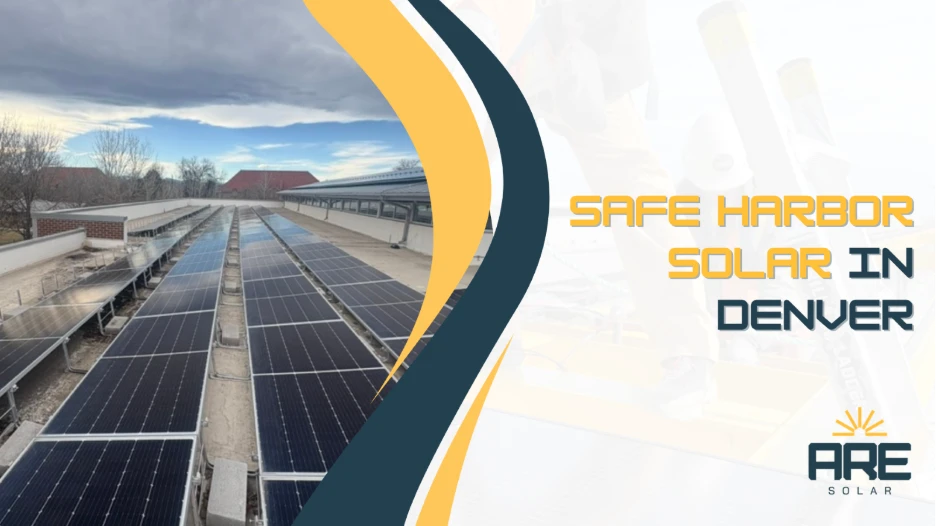
What Denver Commercial Property Owners Should Know
The One Big Beautiful Bill Act changed the timeline for certain clean energy credits. For commercial solar, that created a more urgent planning window.
“Does my solar system need to be fully installed by July 4, 2026?”
Generally, no. The more important question is whether the project began construction before the deadline. That is where safe harbor planning comes in.
Under the accelerated federal timeline, projects that miss the beginning-of-construction deadline may face the December 31, 2027 placed-in-service deadline. That can create pressure for larger commercial systems. These projects rarely move in a straight line.
The point is simple. Incentive eligibility may depend on when construction begins. It may also depend on how that beginning is documented.
Project size matters too. Systems at or below 1.5 MW AC may be treated differently than larger systems. Larger projects often require more detailed planning around physical work.
FEOC rules add another layer. Equipment sourcing may affect tax credit eligibility. That makes early review more important.
This is not a reason to panic. It is a reason to get specific.
What Is Safe Harbor and Why Are Businesses Talking About It?
Safe harbor generally refers to rules for establishing when construction begins. For solar projects, that timing can affect tax credit eligibility.
Project size changes how beginning-of-construction is documented.
The 5% Cost Method
The 5% Cost Method generally looks at incurred project costs. It has often required a taxpayer to incur at least 5% of total eligible project costs before the applicable deadline.
Under IRS Notice 2025-42, the 1.5 MW AC threshold became especially important. That guidance generally limited the 5% Cost Method to smaller solar projects. Larger projects were generally pushed toward the Physical Work Test.
A June 2026 federal court ruling changed that landscape. The court vacated IRS Notice 2025-42. That may reopen the 5% Cost Method conversation for some larger projects.
To be real, this is not settled enough for guessing. New guidance or appeal activity could change the picture again. Current treatment should be confirmed before decisions are made.
The Physical Work Method
The Physical Work Test looks at actual work tied to the solar project. It asks whether construction really began before the deadline.
General planning usually is not enough. A proposal, site review, design work, or permit application may show intent. It may not show physical construction.
Qualifying work may include certain equipment fabrication, site preparation, or installation-related activity. The details depend on the project and current IRS guidance.
The work also needs a clear connection to the final system. A commercial property owner should be able to document what happened, when it happened, and why it matters.
For safe harbor solar in Denver, this test matters because commercial projects take time. The system may not need to be fully installed before the deadline. But the project needs proof that real qualifying work began.
Understanding the New Timeline for Commercial Solar Incentives
Current guidance points to one key issue. Did the project begin before the July 4, 2026 deadline? If yes, the full 30% credit may still be in play.
This matters because commercial projects are rarely completed overnight.
A typical project may involve:
- Energy analysis
- Structural review
- Engineering and design
- Utility coordination
- Permitting
- Equipment procurement
- Installation
- Commissioning
Depending on project size and complexity, the process can take several months. Waiting until the final weeks before a deadline can introduce unnecessary risk.
New FEOC Rules Are Adding Another Layer of Complexity
Foreign Entity of Concern rules are also affecting solar planning. These rules can involve ownership, supply chains, components, and material assistance.
For commercial owners, the practical question is sourcing. Will the equipment support tax credit eligibility? Can documentation support that position? Could future guidance change the risk?
These questions are not theoretical. Equipment choices can affect the project. Procurement timing can affect the project. Documentation can affect the tax conversation.
This is why early planning matters. A rushed project gives owners fewer options. It can also make compliance harder.
The IRS is expected to continue providing additional clarification regarding implementation requirements. ARE Solar is closely monitoring new guidance as it becomes available and will continue providing updates.
The Financial Impact of Preserving the 30% Credit
The numbers can become meaningful very quickly.
Consider a hypothetical commercial solar installation costing $500,000.
If the project qualifies for the ITC solar credit 30%, the federal credit could equal $150,000.
- Project cost: $500,000
- Federal credit: $150,000
- Remaining net cost before additional benefits: $350,000
That is before other possible benefits. Some projects may qualify for bonus credits, depreciation benefits, or other incentives. Eligibility varies by project.
For many commercial properties, the value is not only the tax credit. Solar can also reduce utility exposure. Businesses are not just chasing a deadline. They are evaluating a capital investment under changing federal rules
Why Waiting Creates Risk
Commercial solar projects involve multiple stakeholders and timelines. Engineering reviews, utility approvals, procurement schedules, and installation logistics all require coordination. Waiting too long may reduce available options even if incentives technically remain available.
ARE Solar has worked through snow load reviews, utility delays, and burly roof conditions. We know the difference between a clean drawing and a buildable system.
If the timeline is too tight, we will say so. If more review is needed, we will name it. If the project can move, we will build the next step.
For businesses researching the solar tax credit deadline in Colorado, the best move is not waiting for perfect certainty. The best move is to understand the project early.
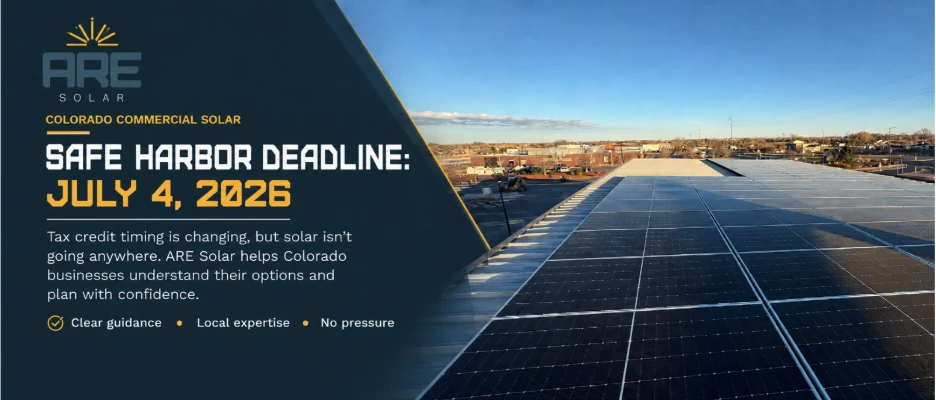
Build Your Solar Strategy Under the Current Timeline
A well-designed system can reduce operating costs. It can support energy planning. It can strengthen a property over time.
Incentives now require more attention to timing, sourcing, documentation, and execution. That makes the installer’s role more important. It also makes early decisions more valuable.
ARE Solar works with commercial property owners throughout Colorado. We evaluate the site, design the system, coordinate the work, and turn it on.
We do not build like solar is an accessory. We build like the system belongs to the property.
Start with a practical project review. Confirm the building, the timeline, and the tax questions. Then decide with the facts in front of you.
If preserving current incentives matters to your project, contact ARE Solar today. We will help you evaluate the path clearly, without pressure, and with the work in view.