Energy costs in Colorado continue to trend upward as utilities expand infrastructure and respond to growing demand. For commercial property owners in Larkspur, this creates a more urgent need to control long-term operating expenses. Many are now evaluating flat roof commercial solar installation in Colorado as a way to stabilize energy costs while improving financial predictability.
Flat roofs present a unique opportunity for solar deployment, but they also introduce specific engineering, structural, and financial considerations. At a glance, systems may appear straightforward. In practice, performance and return on investment depend on how well the design aligns with building conditions, utility requirements, and long-term operating goals.
Understanding how these factors interact helps you evaluate solar as a capital investment rather than a simple equipment upgrade.
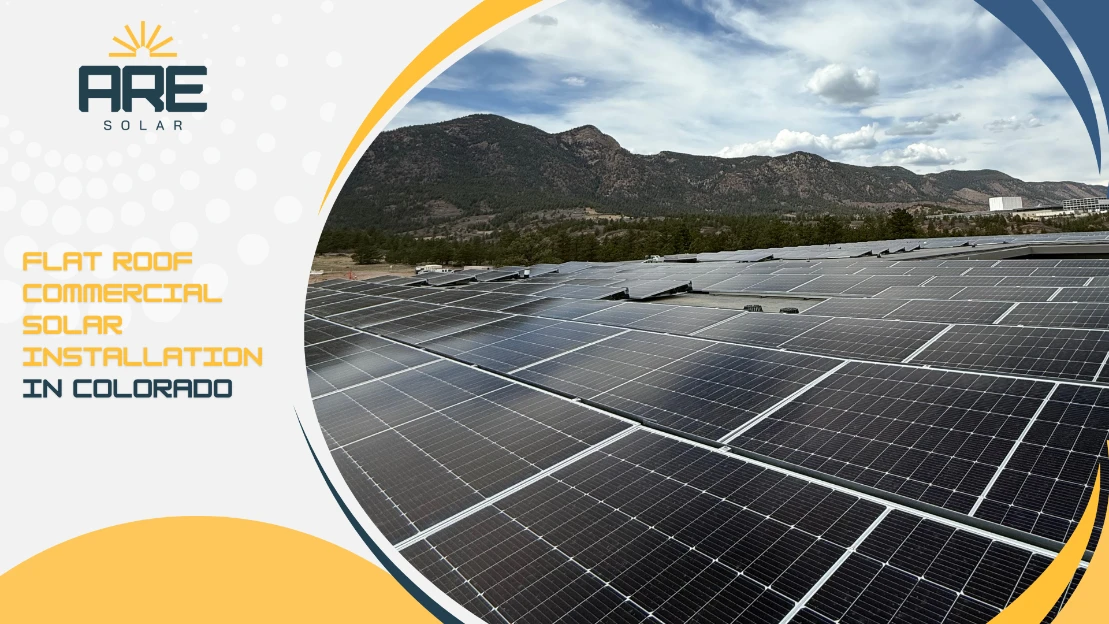
Why Flat Roof Commercial Solar Installation in Colorado Depends on Design Precision
Flat roof systems are not defined by panels alone. Their performance is shaped by mounting strategy, structural capacity, and how production is modeled against real-world conditions.
In Larkspur and across Colorado’s Front Range, elevation increases solar irradiance, which can improve production. At the same time, snow loads, wind exposure, and UV intensity introduce constraints that must be addressed during system design. These environmental variables directly affect panel spacing, tilt angles, and racking selection.
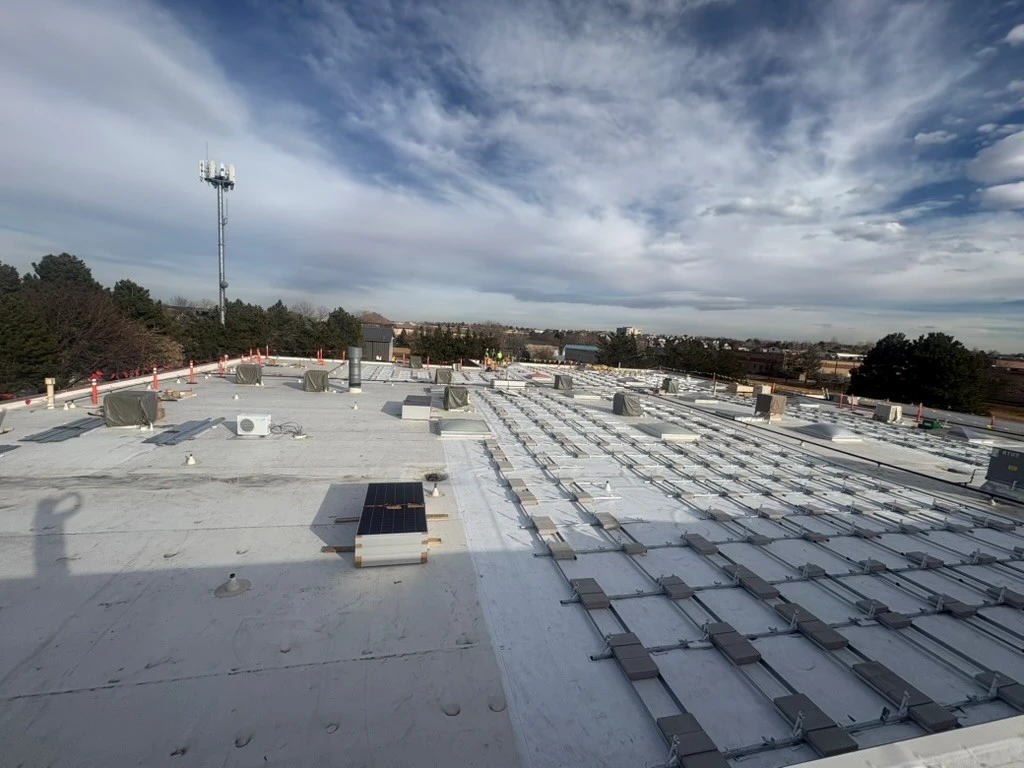
Flat roofs often rely on ballasted systems, which use weight rather than roof penetrations to secure panels. While this approach protects roof integrity, it requires careful structural analysis to confirm load capacity. In some cases, mechanically attached systems may be more appropriate depending on building design and wind uplift requirements.
This is where thoughtful engineering becomes critical. Small design adjustments can significantly impact system output, long-term durability, and overall financial performance.
What This Means for Flat Roof Solar Performance in Larkspur
Flat roofs provide flexibility in layout, but that flexibility must be used strategically. Panel orientation and tilt angles influence how much sunlight the system captures throughout the day and across seasons.
Lower tilt angles can maximize system density, allowing more panels to fit on a roof. Higher tilt angles may improve individual panel performance but reduce total system size due to spacing requirements. The optimal balance depends on your building’s energy profile and long-term financial goals.
For properties considering commercial flat roof solar panels in Larkspur, these design choices directly influence energy offset and ROI. A system that prioritizes maximum capacity may not always deliver the strongest financial return if it does not align with actual energy usage patterns.
This is why production modeling must reflect how your building consumes energy, not just how much roof space is available.
How Structural Constraints Shape System Design
Commercial flat roofs vary widely in age, material, and load-bearing capacity. These factors determine how a solar system can be installed and how much weight the structure can support.
Ballasted systems distribute weight across the roof surface, but they still require verification through structural analysis. Older buildings or roofs with limited capacity may need reinforcement or alternative mounting strategies.
Wind exposure in Larkspur also plays a role. Open commercial areas and elevation changes can increase uplift forces, which must be accounted for in system design. This affects ballast requirements, attachment methods, and overall system layout.
These structural considerations are often not visible in early proposals, but they can significantly influence project scope, cost, and timeline.
Why Utility Integration Affects Financial Outcomes
Xcel Energy requirements shape how solar systems are interconnected and how excess energy is credited. These policies influence system sizing, approval timelines, and long-term financial performance.
In some cases, electrical upgrades may be required to support interconnection. Transformer capacity, service panel limitations, and grid constraints can all impact feasibility. These factors are not always reflected in initial pricing but play a major role in overall project execution.
For businesses evaluating commercial flat roof solar panels in Larkspur, understanding utility integration early helps avoid delays and ensures that system design aligns with current regulations.
The Financial Model Behind Flat Roof Solar Systems
Solar performance is ultimately measured through financial outcomes. While equipment quality matters, return on investment is driven by how accurately the system is modeled.
Production estimates depend on weather data, degradation assumptions, and utility rate projections. If these inputs are overly optimistic or not site-specific, projected savings may not align with actual performance.
Accurate modeling uses conservative assumptions that reflect Colorado’s operating environment. This creates more stable projections and reduces variability over time.
When evaluating flat roof commercial solar installation in Colorado, it is important to look beyond headline savings and understand how those numbers were calculated. Transparent modeling allows you to assess risk, compare proposals, and make informed decisions.
Why Proposal Differences Go Beyond Price
It is common to compare solar proposals based on total cost. However, pricing differences often reflect deeper variations in engineering detail and modeling accuracy.
Some proposals include detailed structural analysis and refined production modeling. Others rely on generalized assumptions that may not fully account for local conditions in Larkspur.
These differences can significantly impact long-term performance and ROI. A lower-cost system may appear attractive upfront but may not deliver the same level of financial stability over time.
This is why proposal evaluation should focus on design quality, not just price.
Long-Term Value Depends on Design Accuracy
Flat roof solar systems are long-term assets, often evaluated over 25 years or more. Early design decisions influence performance, maintenance requirements, and financial outcomes for decades.
Accurate design and modeling lead to more predictable cash flow, stronger alignment between projected and actual performance, and improved asset value. Less precise assumptions can introduce uncertainty and reduce confidence in long-term returns.
For commercial properties, this level of predictability is often as important as the total savings generated by the system.
FAQ: Flat Roof Commercial Solar in Larkspur
How are flat roof solar systems different from pitched roof systems?
Flat roof systems typically use ballasted or low-tilt mounting systems rather than flush-mounted panels. This allows for greater flexibility in orientation and layout but requires careful structural analysis and spacing considerations.
Do flat roofs require penetrations for solar installation?
Many flat roof systems use ballasted designs that avoid roof penetrations. However, some buildings may require mechanically attached systems depending on structural and wind load requirements.
How does Larkspur’s climate affect flat roof solar performance?
High elevation increases solar exposure, which can improve production. At the same time, snow loads, wind patterns, and UV intensity influence system design, material durability, and long-term performance.
What should I review in a solar proposal for a flat roof building?
You should review structural assumptions, mounting strategy, production modeling inputs, and how utility requirements were incorporated. Understanding these factors helps ensure the system is designed for your specific building conditions.
How does solar impact long-term operating costs?
Solar reduces reliance on grid electricity, which helps stabilize energy costs over time. The financial impact depends on system design, energy usage patterns, and utility rate trends.
Design Solar Around Your Building, Not Just Your Roof
Build a Smarter Flat Roof Solar Strategy in Larkspur
We help businesses evaluate flat roof commercial solar installation in Colorado with a focus on engineering precision, financial clarity, and long-term performance.
At ARE Solar, we approach every project as a technical and financial decision shaped by real building conditions and utility requirements.
Let’s assess your flat roof, model your energy profile, and design a solar strategy built for your property in Larkspur.