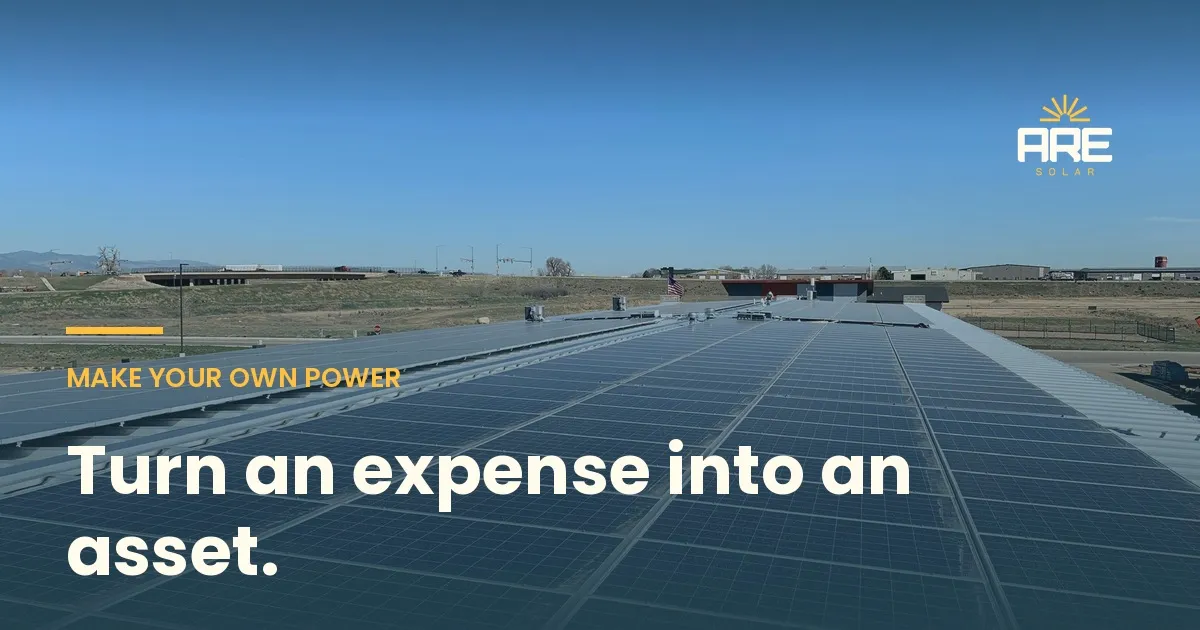
A builder’s read on solar as a depreciating asset that hedges a rising operating cost and the incentive window that’s still open for businesses.
Two things changed in the last year. Most of the news coverage only noticed one.
The homeowner solar tax credit ended. The 30% residential credit closed at the end of 2025 [1]. That story got attention.
Here’s the part that didn’t. The business credit survived. A company installing solar can still claim the commercial credit, up to 30% for qualifying projects under Section 48E [2]. Homeowners lost what businesses kept.
For a Colorado business owner, that asymmetry is the whole story. This is a builder’s read on it. It’s about producing capital, not carbon.
Start with the asset, not the incentive.
Strip out the tax code for a second. Your building pays for power every month. That’s an operating expense you’ll carry for as long as you operate. It rises on a schedule you don’t control- increasing electrical and utility costs.
Solar changes what that expense is. Instead of renting power, you own a system that produces it. On the books, that’s a depreciating capital asset that generates a return and hedges capex. You’ve turned a cost into an asset.
That’s true with or without the credit. The credit just improves the entry price.
Now add the incentive while it’s here.
The commercial 48E credit is still available. But there’s a detail most coverage gets wrong.
The credit follows PTO [2]. You claim it in the year the system is placed in service. That’s the year it’s turned on and producing. Not the year you sign a contract. Not the year you break ground.
So, the date that matters is when it runs.
Here’s where it stands. If your project had construction underway on or before July 4, 2026, you’re locked in. You get up to four years to finish. If it didn’t, the system must be placed in service by December 31, 2027.
That’s the deadline. Miss it, and the credit is gone. Not reduced. Gone.
December 2027 sounds far away. It isn’t. Design, engineering, permitting, utility interconnection, inspection — each one takes time in Colorado. Interconnection alone can stretch a schedule by months.
Now let’s work backward from PTO. That isn’t a sales deadline. That’s a build schedule.
On top of the credit, commercial solar depreciates on an accelerated schedule. MACRS and bonus depreciation front-load the tax benefit into the early years [9]. That shortens effective payback and improves early cash flow.
One honest caveat. The precise credit rate, depreciation period, and bonus percentage all shifted with the 2025 budget law. Some are still unsettled. We don’t give tax advice. These figures belong in a conversation with your accountant. What we can tell you is the direction. The business incentives are real. And the clock on the best of them is running.
The rate story is why the asset earns.
An asset only matters if it produces. This one produces savings, and those savings grow.
Colorado commercial and residential rates rose about 30% between 2021 and 2026 [3]. Regulators project further increases, driven largely by new large-load demand on the grid [4]. Your business sits on that same grid. The rate you pay is heading one way.
Colorado still credits PV electrical generation through net metering [5]. This means every kWh your system produces offsets a kWh you’d otherwise buy at a rising rate. When the utility raises rates, your on-site generation is worth more. The hedge tightens as the market gets worse. That’s the point of owning the asset.
To be real about payback.
We won’t quote you a number for your building. Anyone who does hasn’t seen your roof or your load.
Nationally, commercial solar payback commonly lands around 4 to 8 years [10]. Colorado’s rising commercial rates tend to push toward the shorter end of that range, not the longer. But your real number comes from your usage, your rate schedule, and your roof. That’s what a design tells you.
Where we fit.
We’re ARE Solar, a Denver-based installer. Casey and Clay came up from the roof by hand before they owned the company. So, when we frame solar as a capital asset, we know what that asset physically is. We also know what it takes to make it last.
That matters for a system you’re depreciating over decades. The same crew designs, permits, installs, inspects, and turns it on. We engineer for Colorado conditions: snow, wind, hail. An asset that fails early isn’t a return. It’s a write-off.
We don’t give tax or financial advice. Bring your accountant into the math. What we bring is the build and the honest numbers for your facility.
Your building already pays for power. In 2026, it could make it instead. And the business incentive is still reachable if the system is running by the end of 2027.
If the numbers are worth a look, that’s a conversation worth having.
Sources
1. IRS Fact Sheet 2025-05 — §25D residential credit terminated after Dec 31, 2025 https://www.irs.gov/newsroom/faqs-for-modification-of-sections-25c-25d-25e-30c-30d-45l-45w-and-179d-under-public-law-119-21-139-stat-72-july-4-2025-commonly-known-as-the-one-big-beautiful-bill-obbb
2. Holland & Knight (June 8, 2026) — §48E deadline structure; Notice 2025-42 vacated — ; Sidley Austin OBBBA analysis — https://www.sidley.com/en/insights/newsupdates/2025/07/the-one-big-beautiful-bill-act-navigating-the-new-energy-landscape https://www.hklaw.com/en/insights/publications/2026/06/court-vacates-irs-notice-2025-42
3. Colorado Sun / CPR — CO rates up ~30% 2021–2026 https://coloradosun.com/2023/12/04/utility-bills-increase-xcel-energy-colorado/
4. Colorado PUC analysis via Colorado Sun / CPR — projected further increases from large-load demand https://coloradosun.com/2026/03/12/xcel-building-boom-data-centers-electric-bills/
5. C.R.S. §40-2-124 — Colorado net metering https://codes.findlaw.com/co/title-40-utilities/co-rev-st-sect-40-2-124/
6. SEIA — Depreciation of Solar Energy Property (MACRS) https://seia.org/depreciation-solar-energy-property-macrs/
7. EnergySage / SolarTech — commercial payback ~4–8 yr (national) — Company-Story: `_Shared/Company-Story.md`. Voice: `_Shared/Voice.md`. https://www.energysage.com/solar/understanding-your-solar-panel-payback-period/