Air Technology — Building Energy Management Solutions

Eniscope tells us what a building’s circuits are doing. Air Technology tells us what the rooms are doing.

A single hub, called Air Connect, attaches to the Eniscope Hybrid. From there, wireless sensors and controllers spread across the building.

They run on a long-range, low-power wireless standard called LoRa. No new network wiring, no headaches, one hub can support dozens of devices.
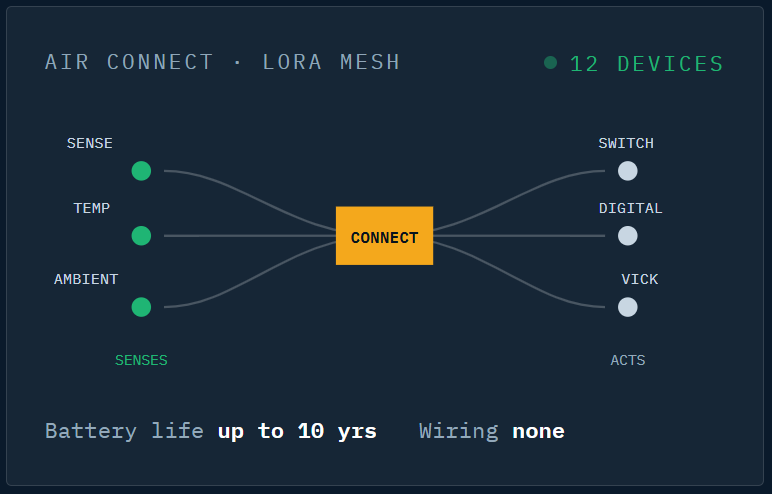
Air Technology · Sensors, switching & control

The lineup

Sensing: What Air Sense Sees

Air Sense is the eyes and ears of the system. It reads temperature, humidity, occupancy, and light in a single room.

It can run on battery power for up to 5 years, longer at slower update rates. No electrician needed to move it later.

That data does more than sit in a dashboard. It feeds directly into the control devices below, telling them when to act.

Air Sense

Air Sense reads temperature, humidity, occupancy, and light in a room. It runs on battery for up to 5 years. It’s often the sensor that tells the others when to act.

Air Ambient

Air Ambient controls air conditioning directly. It works in harmony with the Air Sense device, providing high-accuracy temperature readings from human activity level. One unit can manage up to three HVAC systems.

Air Switch and Air Digital

Air Switch and Air Digital handle equipment itself. Air Switch controls single-phase plug loads. Air Digital controls three-phase equipment, like fryers. Both operate on a schedule, or react to what Air Sense reports.

Air Control

Air Control extends that reach to equipment with analog or digital control inputs. This includes Variable Speed Drives. Where Air Switch and Air Digital simply turn equipment on or off, Air Control sends the actual control signal.

Air Temp

Air Temp adds two more temperature inputs and a door-open monitor, useful for walk-in coolers and freezers.

35 percent — a $120,000 saving
Documented in combination

Why Sensors Alone Aren’t Enough

A sensor that only reports a problem still leaves someone to fix it. Air Technology closes that loop. It reads the condition, then switches the equipment. No one has to remember to turn anything off.

Best Energy’s case studies show this in combination. At Florida’s Kings Point retirement community, five measures ran at once. The project combined retrofit LED lighting, motion sensors, air-conditioning controls, refrigeration savers, and variable-speed pool motor drives. Together, these upgrades cut annual energy spending by up to 35 percent. That translated to $120,000 in savings during the first year. That result belongs to Best Energy’s partner network, not to an ARE install. We cite it because the approach is the same one we deploy.

VICK: Built for the Commercial Kitchen

Commercial kitchens have their own problem: exhaust fans that run at full speed no matter what’s cooking.

VICK reads how hard the fryers below are working and adjusts fan speed accordingly. It doesn’t run at zero or a hundred. It runs at what’s needed.

The physics here is well established. A 30 percent cut in fan speed can return a 65 percent drop in energy use, under the standard engineering relationship between fan speed and power draw.

One Signal, Many Devices, One Energy Management System

None of these devices work in isolation. A door sensor can tell a chiller alarm to sound. An empty room can tell a fryer to shut down.

That’s the difference between monitoring a building and running one. The data doesn’t just get reported. It gets acted on, automatically, the moment it matters.

Frequently Asked Questions

Air Technology adds room-level sensing and equipment control to Eniscope. Eniscope tracks circuit activity, while Air devices monitor operating conditions. The system can then adjust connected equipment when those conditions change.

Air Sense monitors temperature, humidity, occupancy, and light levels. It also supports four analog inputs and one pulse input. Its data can trigger connected controls or support comfort analysis.

Air Switch controls single-phase equipment and monitors its power consumption. Air Digital controls three-phase equipment, including commercial fryers. Both can follow schedules or respond directly to sensor readings.

Yes. Air Control is built for exactly this. It provides the control signals needed to manage devices with analog or digital inputs, including VSDs, so equipment that previously required manual, one-at-a-time adjustment can instead be scheduled and batch-optimized remotely from a central command center.

Air Ambient works with compatible thermistor-input air-conditioning systems. It measures temperature closer to normal human activity levels. One Air Ambient device can control up to three HVAC systems.

Air Sense offers both battery-powered and mains-powered configurations. Battery life can reach 5 years under suitable reporting settings. Actual battery life depends on the selected data update frequency.

Air Temp monitors additional temperatures and open refrigerator doors. CUES controls refrigeration using food temperature instead of unstable air temperature. This approach can reduce compressor cycling and support longer equipment life.

VICK detects fryer activity and adjusts kitchen exhaust fan speeds. Fans operate according to cooking demand instead of running continuously. Actual savings depend on fan design, operating hours, and kitchen demand.

Air devices communicate through a wireless LoRa network. This reduces new data cabling throughout the commercial property. Equipment controls still require proper installation and electrical coordination.

Not every commercial building needs every available Air device. We identify equipment schedules, operating patterns, and recurring energy waste. Then we match appropriate controls to verified building conditions.