What Eniscope Does: Real-Time Energy Monitoring for Colorado Businesses
A utility bill arrives once a month. By then, the waste is long gone.
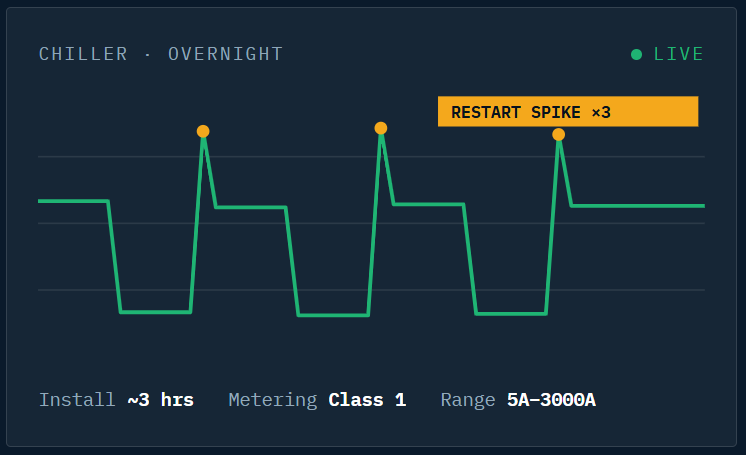
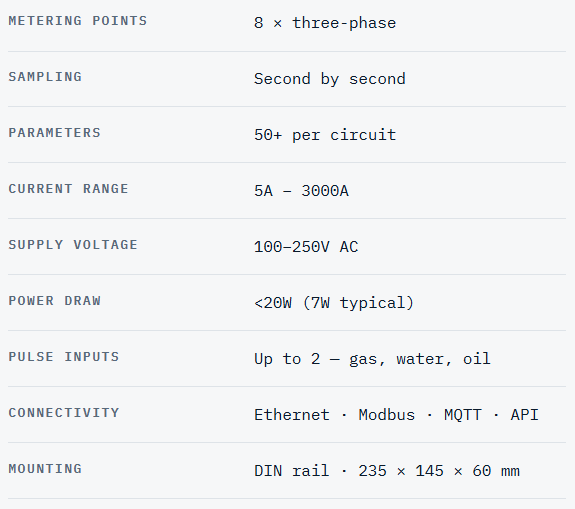
Eniscope mounts at your electrical panel and watches instead. It meters up to eight three-phase circuits, second by second.
That data feeds a cloud platform we can view from anywhere. No separate software, no site visit required to check a number.
This is the foundation of everything we do in commercial energy work. Every audit, every recommendation, starts with what Eniscope sees.
One panel-mounted device, one full picture
Eniscope reads over 50 parameters — voltage, power factor, load, and more.
It isn’t limited to electricity. Pulse inputs connect your existing gas and water meters into the same dashboard.
Add temperature probes and the system covers refrigeration and HVAC performance too. One panel-mounted device, one full picture of building consumption.
Installation runs around three hours, done by a licensed electrician. The system is plug-and-play once it’s wired in.
From Data to Action
Second-by-second data is only useful if something acts on it. Eniscope’s alarms do that automatically.
A compressor running rough gets flagged before it fails completely. Consumption outside business hours triggers a notice, not a surprise on next month’s bill.
Eniscope tells you where the waste lives. It doesn’t act on its own. That’s where Air Technology becomes the sensor and control layer. It monitors occupancy, temperature, and equipment behavior in real time. The system then shuts down equipment when it’s no longer needed.
Eniscope and Air Technology work as one system. Think of Eniscope as the meter, and Air as the hands.
What Commercial Building Energy Monitoring Has Found
Best Energy’s global partner network has used Eniscope to catch problems that sat undiagnosed for years.
At one Florida university, a fault in the water-chilling system had gone unnoticed for five years. Eniscope data found it in four weeks, a documented 30 percent savings in that building, at zero repair cost.
At Hillsborough County Public Schools, Best Energy’s network installed more than 1,000 Eniscope units. They’re part of a $500 million LED retrofit spanning 290,000 fixtures. Eniscope set the benchmark the whole project was financed against. It verifies savings and flags faulty equipment. Projected savings run near $8 million a year across the district. Energy savings so far are running 15 to 20 percent.
Results like these depend on the same discipline every time: measure first, then decide. That’s the order we follow on every building we touch.
The Number We Measure Before We Recommend Anything
This process typically eliminates around 18 percent of a building’s energy waste. We install the hardware, baseline the building, and let the data speak before we recommend anything.
Curious what your panel would show? Send us a recent utility bill. We’ll tell you plainly what monitoring would likely find.